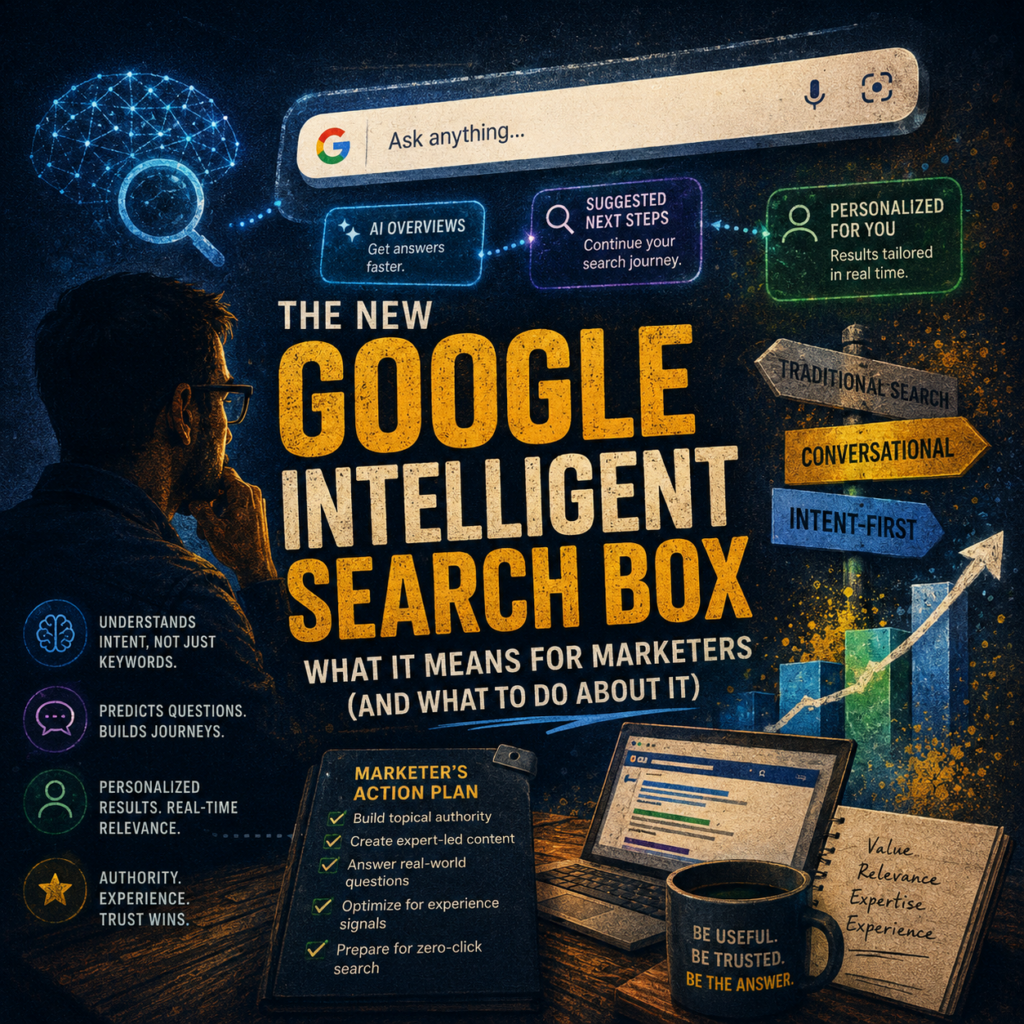
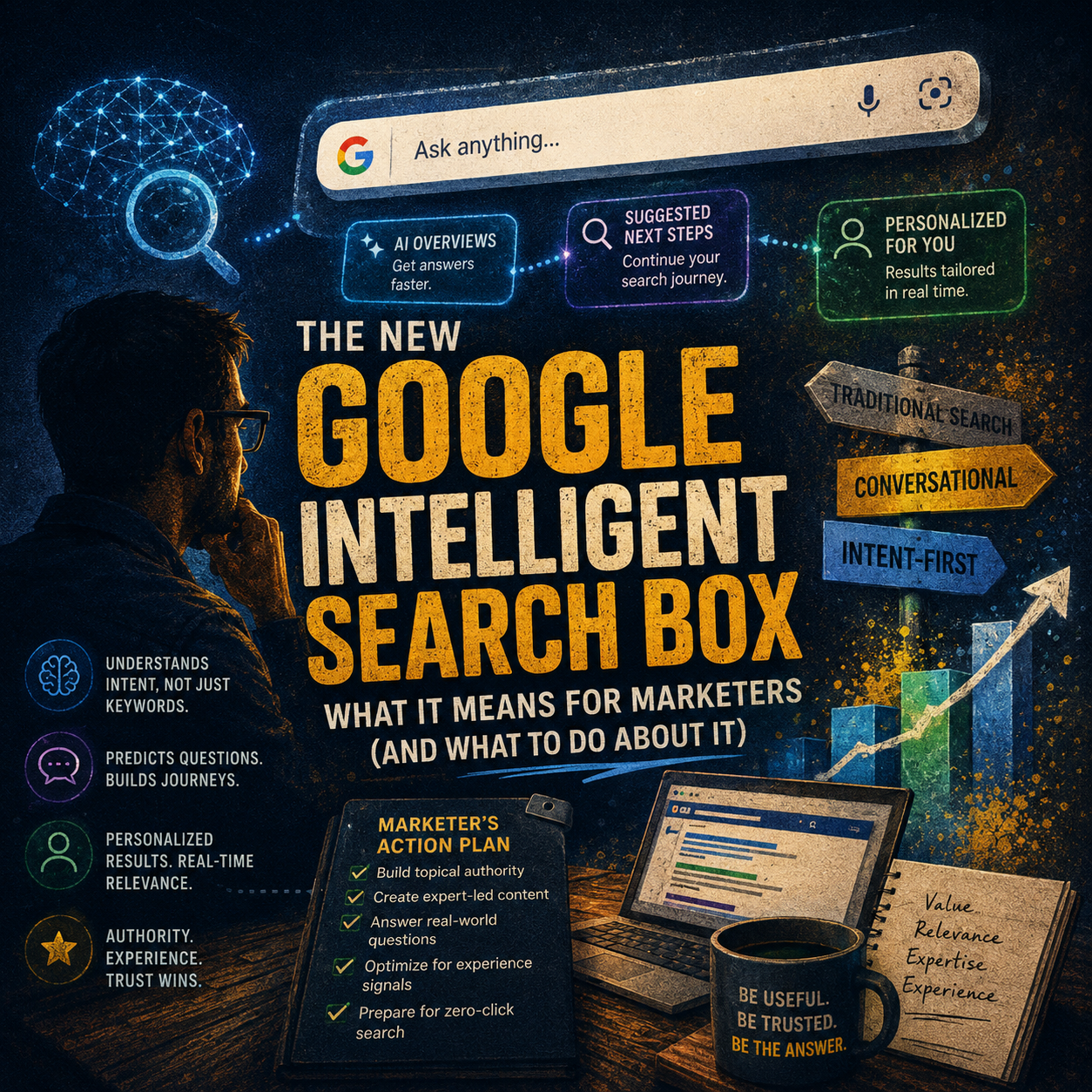
Google has quietly been redesigning the way people search for years, but the introduction of the new “intelligent search box” marks a much bigger transition than most businesses realize.
This is not just another interface update.
It’s a behavioral shift.
For search professionals, marketers, and business owners, the intelligent search box represents Google moving away from simple keyword retrieval and toward predictive, conversational intent resolution. In plain English: Google no longer wants users to “search better.” It wants to understand what they mean before they fully ask.
And that changes everything.
Search Is Becoming Predictive Instead of Reactive
Traditional search has always worked on a simple formula:
- User types keywords
- Google retrieves matching pages
- Rankings determine visibility
The intelligent search box changes that model by layering AI interpretation directly into the query process itself.
Now Google is:
- Predicting follow-up questions
- Rewriting unclear intent
- Suggesting contextual paths
- Building search journeys before the user finishes typing
- Personalizing discovery in real time
This creates a fundamentally different experience than the classic “10 blue links” era.
Users are no longer searching in isolated moments.
They’re entering dynamic conversations.
Why This Matters for SEO
Most SEO strategies were built around keyword targeting.
But intelligent search reduces Google’s reliance on exact-match phrasing and increases its reliance on semantic understanding.
That means businesses focusing only on:
- keyword density,
- rigid page optimization,
- or outdated ranking formulas
are going to struggle.
Google’s AI systems are becoming increasingly focused on:
- topical authority,
- contextual relevance,
- entity relationships,
- behavioral satisfaction,
- and trust signals.
The question is no longer:
“Does this page contain the keyword?”
The question is now:
“Does this source genuinely solve the broader intent behind the query?”
That’s a major evolution.
The Rise of Conversational Search
One of the biggest implications of the intelligent search box is the acceleration of conversational search behavior.
People are already searching differently because of AI tools like ChatGPT, Gemini, and Perplexity.
Instead of typing:
“best HVAC Phoenix”
Users now ask:
“Who’s the most reliable HVAC company in Phoenix for older homes with energy efficiency issues?”
Google knows this shift is happening.
The intelligent search box is Google’s attempt to adapt traditional search behavior to AI-era expectations.
This means content creators and businesses need to rethink how they structure information online.
Pages optimized only for short-tail keywords may lose ground to content that:
- answers layered questions,
- anticipates follow-up concerns,
- and demonstrates real expertise.
User Intent Is Becoming More Important Than Rankings
At Weboganic, we’ve been watching Google move steadily toward intent-first search for years.
This latest development confirms something we’ve been telling clients for a long time:
Search visibility is increasingly earned through usefulness, not manipulation.
Google’s intelligent systems are evaluating:
- engagement patterns,
- satisfaction signals,
- contextual depth,
- and likely next actions.
In many cases, the best-performing content is no longer the most “optimized” page.
It’s the most complete answer.
That changes how businesses should think about SEO investment.
AI Search Experiences Will Shrink Low-Quality Traffic
Here’s the uncomfortable reality many publishers don’t want to discuss:
AI-assisted search experiences are going to reduce clicks to low-value websites.
If Google can answer basic informational questions directly inside the search experience, thin-content websites lose their reason to exist.
That means businesses relying on:
- recycled blog content,
- mass-produced SEO pages,
- or generic affiliate strategies
may see major declines in organic traffic over the next few years.
The intelligent search box is another step toward compressing the user journey.
Google wants fewer dead ends and faster resolution.
Only genuinely authoritative brands are likely to benefit long term.
What Businesses Should Be Doing Right Now
The companies that win in this next era of search will focus on depth, expertise, and user experience.
Here’s what I believe matters most moving forward:
1. Build Topical Authority
Stop chasing isolated keywords.
Own categories.
Develop comprehensive content ecosystems around your expertise.
2. Write Like Humans Search
Conversational search is growing fast.
Your content should naturally answer real-world questions, not robotic keyword strings.
3. Focus on Experience Signals
Page quality, trust, usability, speed, and engagement all matter more in AI-assisted search environments.
4. Create Expert-Led Content
First-hand expertise is becoming increasingly important.
Google wants signals that content comes from knowledgeable, credible sources.
5. Prepare for Zero-Click Search
Visibility will matter differently moving forward.
Brand authority, citations, mentions, and AI inclusion may become just as important as direct website traffic.
This Is Bigger Than an Algorithm Update
The intelligent search box is not just a feature.
It’s another signal that Google is redefining what search actually is.
We are moving from:
- search engines
to - answer engines.
From:
- keyword matching
to - intent modeling.
From:
- rankings
to - resolution.
For search professionals, this is one of the most important transitions we’ve seen in over a decade.
The businesses that adapt early will have a significant advantage.
The ones still relying on outdated SEO tactics may discover that visibility in AI-powered search looks very different than it did even two years ago.
And honestly, we’re only at the beginning..