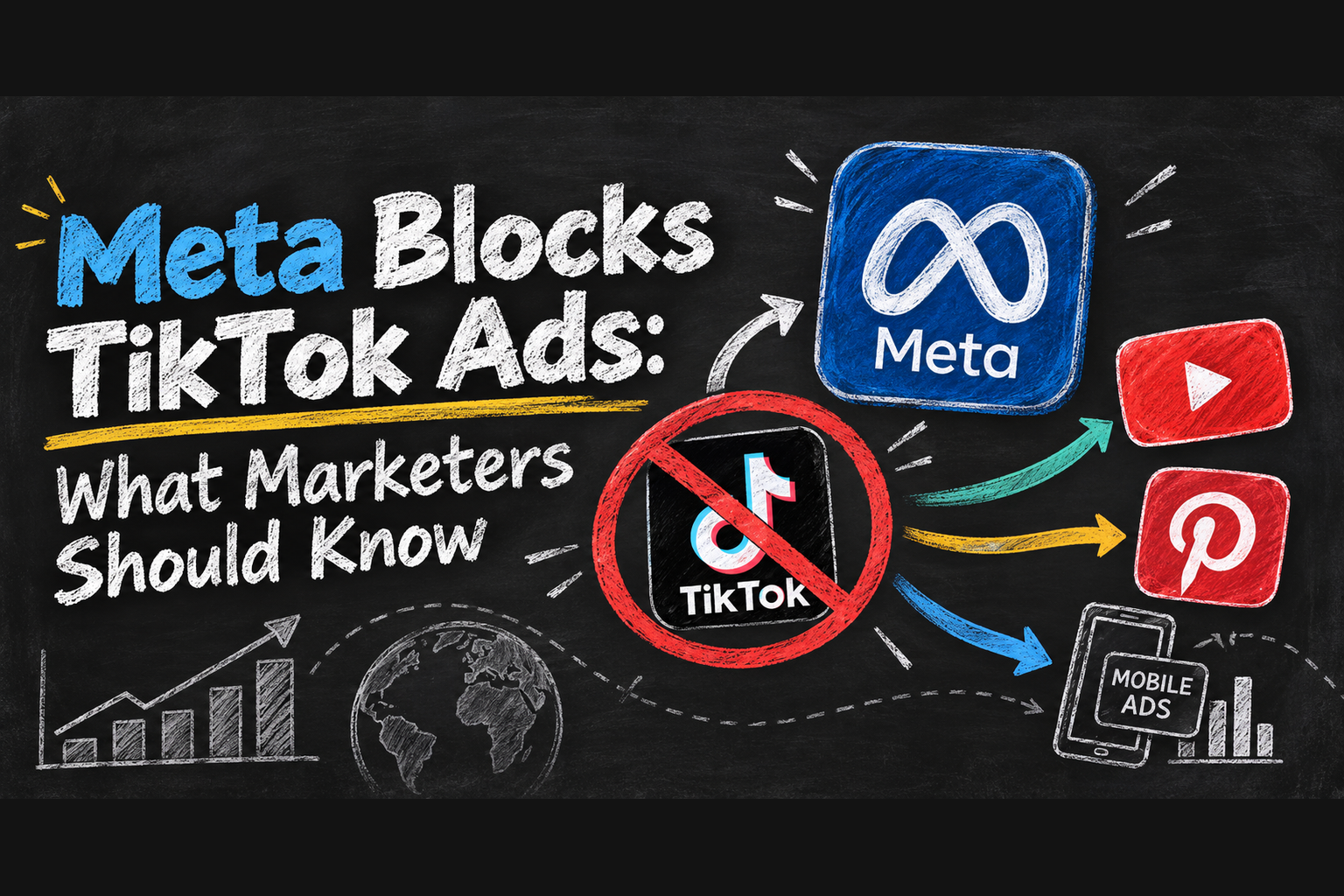
The competition between the world's largest social media platforms has taken an interesting turn. Meta, the parent company of Facebook and Instagram, has blocked TikTok's parent company, ByteDance, from advertising across its platforms in several major markets.
TikTok's response? Take its advertising dollars elsewhere.
According to an October 21 report from Business Insider, TikTok has begun redirecting substantial advertising budgets toward YouTube, Pinterest, and mobile advertising networks.
While the dispute involves two of the world's largest social media companies, the implications extend well beyond their rivalry. For businesses and digital marketers, the situation highlights an increasingly important reality: advertising platforms control not only how businesses reach consumers, but sometimes whether they can reach them at all.
Why Meta Blocked TikTok
On October 8, 2026, Meta implemented restrictions preventing ByteDance from advertising on its platforms in seven countries, including the United States, Canada, Japan, Indonesia, Thailand, Vietnam, and Egypt.
Meta's reasoning was straightforward. TikTok is a direct competitor for consumer attention, engagement, and advertising revenue. Allowing TikTok to purchase Facebook and Instagram ads effectively enables a competing platform to use Meta's audience to acquire new users.
The restrictions also extend to third-party advertisers directing traffic to TikTok and other ByteDance properties, creating potential complications for businesses that use TikTok as a destination for their marketing campaigns.
This raises an interesting question: When the companies that operate advertising networks also compete with the businesses purchasing advertising, where does the line fall between protecting their interests and limiting competition?
For Meta, the decision represents a strategic business move. For marketers, it provides another reminder that access to digital advertising audiences is never entirely guaranteed.
TikTok's Advertising Dollars Are Moving Quickly
TikTok hasn't wasted time finding alternative advertising channels.
According to Sensor Tower estimates reported by Business Insider, the distribution of TikTok's advertising spending shifted dramatically following Meta's restrictions.
- YouTube: Increased from 9% to 17% of TikTok's measured advertising spending.
- Pinterest: Increased from 3% to 9%.
- Mobile advertising networks: Increased from 19% to 58%, including networks such as Google's AdMob.
These figures compare the first week of October with October 9–16 and represent estimated shares of advertising spending, not necessarily increases in total advertising dollars.
The most significant shift was toward mobile advertising networks, where TikTok can continue reaching potential users through thousands of apps and digital properties.
For marketers, the lesson is not simply that YouTube and Pinterest are gaining advertising revenue. It's that even a company with TikTok's resources and sophistication must adapt quickly when a major distribution channel becomes unavailable.
The Growing Power of Advertising Platforms
Google, Meta, TikTok, Amazon, Microsoft, and other major technology companies have built sophisticated advertising ecosystems that connect businesses with billions of consumers.
Those ecosystems offer tremendous advantages, including advanced targeting, automated bidding, audience insights, and measurable advertising performance.
However, they also create dependencies.
An advertiser can spend years building successful campaigns on a particular platform, only to encounter changes involving advertising policies, targeting restrictions, account eligibility, algorithms, or available inventory.
The Meta–TikTok dispute illustrates how quickly those dependencies can become business challenges.
And while most advertisers aren't direct competitors of Meta or Google, the broader concern remains relevant: Businesses do not own the advertising platforms on which they depend.
Why Diversification Matters More Than Ever
For many organizations, digital advertising begins with Google Ads or Meta advertising. Both offer extensive reach and proven opportunities for customer acquisition.
But concentrating an entire marketing strategy on one or two platforms creates unnecessary exposure.
A more resilient approach evaluates several advertising channels based on audience behavior, business objectives, and measurable performance.
Google Search and Microsoft Advertising can capture demand from consumers actively researching products and services. YouTube can combine broad awareness with audience targeting and video engagement. Meta continues to provide substantial reach through Facebook and Instagram.
Meanwhile, Pinterest, Reddit, programmatic display, connected television, and emerging AI-powered advertising environments offer additional opportunities to reach audiences at different stages of their decision-making process.
Not every business needs to advertise everywhere. In fact, spreading a limited budget across too many platforms can reduce effectiveness.
The objective is to identify a combination of channels that produces measurable results while reducing dependence on any single advertising provider.
A Changing Advertising Landscape Creates New Opportunities
One of the more interesting aspects of TikTok's response is how quickly advertising spending can migrate between competing platforms.
When advertisers move significant budgets, those shifts can create opportunities and challenges for other businesses.
Increased demand for advertising inventory can influence competition and pricing. New advertisers entering a platform may also accelerate improvements in its advertising products, measurement capabilities, and targeting technology.
At the same time, emerging platforms are competing more aggressively for marketing budgets. The expansion of AI-powered discovery, conversational search, and advertising within AI environments introduces another dimension to this competition.
As consumers increasingly explore products, services, and businesses through AI-assisted experiences, advertisers will need to evaluate how these environments fit alongside traditional search, social media, and display advertising.
The next generation of digital marketing may be less about choosing a dominant platform and more about understanding how consumers move between multiple discovery environments.
What Businesses Should Do Now
The Meta–TikTok dispute doesn't mean businesses should immediately shift their advertising budgets away from Facebook or Instagram. Both remain important advertising channels for many organizations.
Instead, businesses should use developments like this as an opportunity to evaluate the strength and flexibility of their marketing strategies.
Consider three questions: 1. How dependent is your business on one advertising platform? If most qualified leads, sales, or customer inquiries originate from a single advertising provider, changes to that platform could create significant business risk. 2. Are there additional channels capable of reaching your target audience? Understanding where prospective customers research, compare, and make purchasing decisions can reveal opportunities beyond existing campaigns. 3. Can you accurately measure performance across multiple platforms? Diversification only works when advertisers can evaluate results consistently. Reliable conversion tracking, lead-quality analysis, and cost-per-acquisition reporting are essential for determining where advertising dollars deliver the greatest value.
These considerations should be part of an ongoing marketing strategy rather than a reaction to the latest industry headline.
The Bigger Picture: Adaptability Is a Competitive Advantage
The dispute between Meta and TikTok demonstrates that digital advertising is becoming increasingly competitive, interconnected, and unpredictable.
Even the largest technology companies must adjust their marketing strategies when access to advertising inventory changes.
For businesses, the takeaway is straightforward: A successful digital marketing strategy should be built around reaching the right audience and producing measurable business outcomes, not maintaining a permanent commitment to any single platform.
At Weboganic, we believe effective digital marketing requires both specialized platform expertise and the flexibility to adapt as technology, consumer behavior, and advertising opportunities evolve.
As a Google Premier Partner with experience across paid search, social media, video, programmatic advertising, and emerging digital platforms, Weboganic helps organizations evaluate where their advertising investments can deliver the strongest results. The platforms may change. The objective remains the same: connecting businesses with the people most likely to become their customers.
---Source: Business Insider — TikTok Is Shifting Advertising to YouTube After Meta Says 'No Thanks', October 21, 2026.